
Check out our data plans here!
Fleet vehicles aren’t just moving assets anymore — they’re mobile offices, communications hubs, and remote monitoring nodes that need persistent internet connectivity to function. A driver needs dispatch instructions. A transit bus streams passenger WiFi. A utility crew uploads sensor data from a remote substation. A public safety vehicle requires always-on FirstNet access during an active incident. In every one of these cases, the cellular router mounted in that vehicle determines whether operations run smoothly or break down entirely.
Consumer hotspots and home routers don’t survive vehicle deployments. They weren’t built for ignition cycling, temperature extremes, DC power fluctuations, vibration, or the RF challenges of a vehicle moving through variable coverage areas. The routers on this list were.
What Makes a 5G Router Fit for Fleet Deployment
Before comparing devices, it’s worth being explicit about what separates a vehicle-grade cellular router from a standard commercial router:
- Vehicle power input: Wide DC input voltage range (typically 10–30V) for direct vehicle electrical system integration — including voltage spike protection and reverse polarity protection
- Ignition sensing: GPIO port or dedicated circuit that detects vehicle ignition state and powers the router on/off automatically, preventing battery drain when the vehicle is parked
- Vehicle certifications: E-Mark (European vehicle safety), SAE J1455 (heavy truck environmental), or EN50155/EN61373 (railway vibration and shock) confirm the hardware survived standardized vehicle environment testing
- Temperature range: Operating range extending to at least -25°C to +60°C — vehicles see extremes that indoor equipment never encounters
- External antenna support: SMA or N-type connectors for external cellular antennas — through-glass, shark-fin, or roof-mount antenna systems that dramatically improve signal when the vehicle is the obstacle
- IP rating: At minimum IP54 for splash resistance in cab environments; IP64+ for exterior/underbody mounting
Best 5G Routers for Fleet and Vehicle Deployments
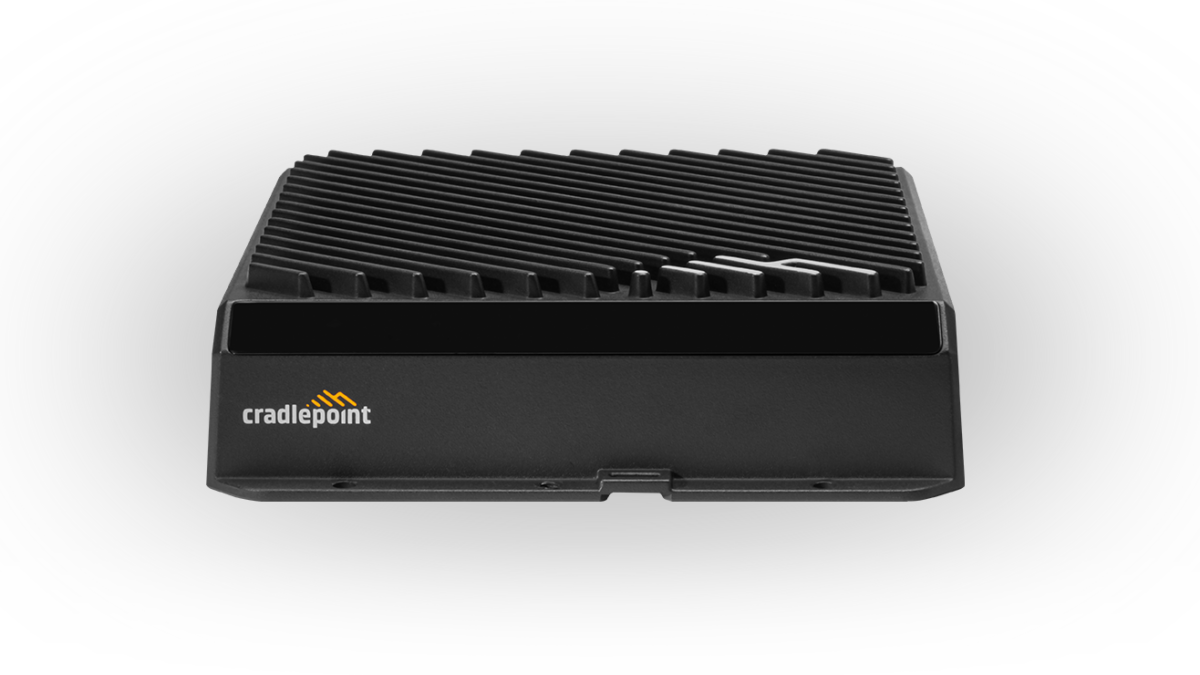
1. Cradlepoint R1900 — Best for Public Safety and Enterprise Fleets
The Cradlepoint R1900 is the flagship choice for organizations where failure isn’t an option — public safety agencies, government fleets, and enterprise operations running mission-critical vehicle communications. It checks every vehicle-grade box: IP64 dust-tight and splash-resistant enclosure, E-Mark European vehicle safety certification, SAE J1455 heavy truck environmental certification, ignition sensing GPIO, and a wide DC input voltage range.
On the connectivity side, the R1900 delivers 5G Sub-6 GHz with CAT 20 LTE (4.14 Gbps theoretical downlink), 4×4 MIMO cellular, dual Nano-SIM slots, four switchable GbE Ethernet ports, and WiFi 6. Carrier certifications include Verizon Frontline Verified, AT&T FirstNet Trusted, and T-Mobile Connecting Heroes — the public safety tier of carrier certifications that law enforcement, fire, and EMS agencies often require for procurement approval.
The R1900 requires a Cradlepoint NetCloud subscription (included in all hardware purchases), which provides zero-touch provisioning, centralized policy management, and advanced SD-WAN across the entire fleet from a single console. For large enterprise fleet operators who need that management depth, NetCloud is worth the subscription. For smaller fleets, it adds meaningful per-unit recurring cost.
Best for: Public safety fleets, government agencies, enterprise mobile operations, utility emergency response vehicles
2. Peplink MAX BR1 Pro 5G — Best All-Around Enterprise Vehicle Router
The Peplink MAX BR1 Pro 5G hits the right balance of performance, vehicle-grade durability, and cost for enterprise fleet deployments that don’t require public safety carrier program certifications. EN50155 railway vibration certified and EN61373 shock/vibration certified, with ignition sensing GPIO, a -40°C to +65°C operating range, and a 10–30V DC input for vehicle power — it was built for vehicle environments even if it doesn’t carry the E-Mark badge.
The BR1 Pro 5G runs a Qualcomm X62 modem for 5G Sub-6 and CAT 20 LTE, with 4×4 MIMO, dual Nano-SIM slots, a dedicated 2.5 GbE WAN port, two GbE LAN ports, and WiFi 6. Verizon C-Band (n77) certified, AT&T FirstNet approved, and T-Mobile certified. SpeedFusion failover means traffic reroutes to a secondary WAN path the instant a connection drops — with no session interruption for drivers and connected systems.
At approximately $999 with 1-year PrimeCare included, the BR1 Pro 5G costs significantly less per unit than the R1900 for fleet operators managing large numbers of vehicles where the R1900’s public safety carrier program credentials aren’t a procurement requirement.
Best for: Enterprise delivery fleets, construction vehicle offices, MSP fleet deployments, corporate mobile operations
3. Peplink MAX Transit Duo Pro — Best for Dual-Carrier Redundancy
The Peplink MAX Transit Duo Pro is the choice when one cellular modem isn’t enough. With two independent CAT 12 + CAT 7 LTE modems and four Nano-SIM slots (two per modem), the Transit Duo Pro simultaneously maintains active connections on up to four carrier SIMs — and SpeedFusion can bond all four links into a single high-availability WAN pipe.
Designed explicitly for vehicle deployment with EN50155/EN61373 certifications, ignition sensing, and a wide DC input range, the Transit Duo Pro handles the route-based coverage variability that single-modem routers struggle with. When Verizon signal drops in a tunnel or rural corridor, T-Mobile picks up the session. When T-Mobile’s tower is congested during an event, Verizon carries the load. The result is consistent connectivity across diverse coverage environments that no single-carrier solution can reliably deliver.
WiFi 6 onboard handles in-vehicle wireless devices, and two GbE Ethernet ports connect wired onboard systems. Vehicle-mounted at $1,199, the Transit Duo Pro is a premium investment in coverage continuity for routes where consistent connectivity is operationally critical.
Best for: Long-haul transit routes, passenger rail, tour operators, emergency response units covering large geographic areas
4. Peplink HD1 Dome Pro — Best for Exterior Roof-Mount Deployment
Most vehicle routers mount inside the cab and require separate external antenna hardware for decent signal. The Peplink HD1 Dome Pro takes a different approach — it’s an all-in-one cellular router and antenna system designed for roof-mount installation, with an integrated MIMO antenna array in a weatherproof IP67 dome enclosure.
Inside the dome: a 5G Sub-6 CAT 20 modem, 4×4 MIMO antenna integration, WiFi 6, dual Nano-SIM slots, and a PoE connection back to an interior switch or access point. IP67-rated for full waterproofing, the dome survives rain, car washes, road spray, and the full outdoor temperature range. Vehicle certifications (EN50155/EN61373) confirm it handles vehicle vibration and shock.
For fleet operators whose vehicles travel through variable coverage areas and need consistent signal regardless of vehicle position and orientation, the HD1 Dome Pro’s integrated antenna system outperforms an indoor router with an aftermarket antenna in practical testing. At $2,799, it’s a premium solution — but the installation simplicity (one PoE cable vs. router + antenna cabling) often reduces total install cost per vehicle.
Best for: Transit buses, emergency service vehicles, last-mile delivery vehicles, passenger ferry and marine applications
5. Peplink MAX BR1 Mini 5G — Best Budget Vehicle Router
Not every fleet vehicle needs a $1,000+ router. For light-duty fleet applications — company cars, delivery vans, service vehicles, or any deployment where you need basic 5G connectivity and failover without the full enterprise feature set — the Peplink MAX BR1 Mini 5G delivers solid performance at around $499.
The BR1 Mini 5G includes vehicle mounting support, EN50155 certification, ignition sensing, wide DC input voltage range, WiFi 5, a single WAN port, and dual Nano-SIM slots — covering the core vehicle deployment requirements at roughly half the cost of the BR1 Pro 5G. It’s the right router for fleets where per-vehicle connectivity budget matters and the advanced features of the higher-end units would go unused.
Best for: Light commercial fleets, corporate car programs, service vehicle networks, budget-conscious MSP fleet deployments
Fleet Router Comparison at a Glance
| Router | LTE Cat | Vehicle Cert | IP Rating | SIM Slots | Approx. Price |
|---|---|---|---|---|---|
| Cradlepoint R1900 | CAT 20 | E-Mark, SAE J1455 | IP64 | 2 | Partner pricing |
| Peplink BR1 Pro 5G | CAT 20 | EN50155/EN61373 | None | 2 | ~$999 |
| Peplink Transit Duo Pro | CAT 12+7 | EN50155/EN61373 | None | 4 | ~$1,199 |
| Peplink HD1 Dome Pro | CAT 20 | EN50155/EN61373 | IP67 | 2 | ~$2,799 |
| Peplink BR1 Mini 5G | CAT 20 | EN50155 | None | 2 | ~$499 |
Carrier Considerations for Fleet Deployments
Fleet vehicles move. A router certified only for one carrier will encounter coverage gaps on routes where that carrier has holes. All five routers on this list carry Verizon, AT&T, and T-Mobile certifications — but dual-SIM and multi-modem configurations take this further by maintaining active connections on multiple carriers simultaneously.
For fleet operators whose vehicles travel nationally: the Transit Duo Pro with four SIM slots (two carriers simultaneously active) provides the most resilient coverage architecture. For regional fleets with predictable routes: a dual-SIM single-modem router with a primary SIM and a standby SIM from a different carrier handles most outage scenarios at lower cost.
Managing Fleet Cellular with ISPTek Data Plans
Every router on this list uses a standard Nano-SIM (or Mini-SIM for the RUT956). ISPTek’s cellular SIM card data plans work with all of them — and for fleet operators managing 10 to 500+ vehicles, ISPTek’s pooled data plans provide significant operational advantages over per-device SIM management:
- Single account for the entire fleet: All vehicle SIMs billed and managed under one ISPTek account, regardless of which router hardware is in each vehicle
- Pooled data across the fleet: Vehicles with light data usage on a given month contribute unused data to the pool that heavy-usage vehicles draw from — no waste, no overage surprises
- Public static IPs: Fixed IP addresses on fleet vehicles enable remote management via Peplink InControl2 or Cradlepoint NetCloud, VPN tunnel termination, and direct device access for diagnostics
- No activation fees: Add new vehicles to the fleet account as the fleet grows; retire SIMs as vehicles are cycled out — no per-activation costs
The routers handle the hardware and management. ISPTek handles the cellular data. Together, they give fleet operators everything needed to keep every vehicle connected — reliably, at scale, and with predictable costs. View ISPTek’s cellular SIM card data plans and get your fleet online today.
