
Check out our data plans here!
When an MSP is standardizing on a cellular router platform across dozens or hundreds of client sites, one of the first decisions that shapes everything downstream — pricing, management overhead, carrier flexibility, support structure — is the platform decision: Peplink or Cradlepoint. Both are legitimate enterprise-grade options with deep carrier certification histories and active MSP channel programs. But they represent meaningfully different philosophies around hardware flexibility, management, and total cost of ownership. This comparison walks through the key differences so you can make the right call for your portfolio.
Why Platform Choice Matters More Than Individual Devices
At the individual device level, both Peplink and Cradlepoint check the same boxes: 5G Sub-6, WiFi 6, dual SIM, WAN failover, Verizon/AT&T/T-Mobile certified. A comparison of the Peplink MAX BR1 Pro 5G and the Cradlepoint R1900 shows two very capable enterprise routers with similar core specs.
But MSPs don’t buy one router. They standardize on a platform — and platform selection determines the management interface your technicians learn, the licensing model that shapes your per-site recurring revenue, the vendor relationship you’re building, and the resale and support structure you’re locked into. Those decisions have long tails. Platform migration is painful. Get it right the first time.
Peplink at a Glance: Range, Flexibility, and SpeedFusion
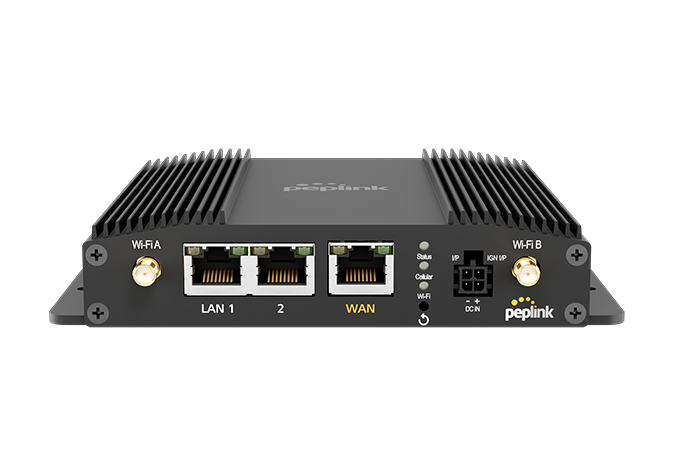
Peplink covers the widest range of cellular router form factors of any major vendor — from the pocket-sized MAX BR1 Mini 5G for small site deployments, to the enterprise MAX BR1 Pro 5G for vehicle and branch deployments, to multi-modem platforms like the MAX Transit Duo Pro and the MAX BR2, plus outdoor 5G domes like the HD1 Dome Pro, for demanding fleet applications. Dedicated branch routers round out the lineup, from the B One 5G for branch offices and restaurant chains to the WiFi 7 Balance 310 5G with a 10G WAN port for enterprise branch networks. MSPs can standardize on a single management system (InControl2) across that entire portfolio.
Peplink’s core technology differentiator is SpeedFusion — a proprietary WAN bonding protocol that can aggregate multiple cellular connections, wired WAN links, and WiFi-as-WAN sources into a single bonded pipe with hot failover, Forward Error Correction (FEC), and bandwidth balancing. For MSPs running sites where connectivity continuity is a contract obligation, SpeedFusion provides meaningful SLA assurance beyond what basic failover delivers.
Hardware purchases include a PrimeCare subscription (1-year bundled, with annual renewal priced by device tier — $49 for the BR1 Mini 5G, $149 for the BR1 Pro 5G) that covers cloud management via InControl2, technical support, firmware upgrades, and hardware warranty. PrimeCare is strongly recommended but technically not mandatory for basic functionality — this is a meaningful distinction from Cradlepoint’s fully mandatory subscription model.
Cradlepoint at a Glance: NetCloud-First, Enterprise-Ready
Cradlepoint (now Ericsson Cradlepoint) builds devices that are explicitly designed around the NetCloud management platform. The R1900 is the flagship 5G ruggedized router — IP64 rated, E-Mark and SAE J1455 vehicle certified, and approved under Verizon Frontline, AT&T FirstNet, and T-Mobile Connecting Heroes. It’s a tier above most Peplink devices in physical ruggedization and carrier program certifications.
Cradlepoint’s pitch to enterprise and public safety buyers is tight platform integration: every device is sold exclusively as a NetCloud bundle, the hardware is not sold standalone, and the management subscription is mandatory for operation. For enterprise IT organizations that want a centrally enforced policy framework, SD-WAN orchestration, and FedRAMP-authorized management for government deployments, this tight integration is a feature. For MSPs evaluating TCO, it’s a cost structure that needs careful analysis.
Hardware Comparison: Key Models Side by Side
| Spec | Peplink MAX BR1 Pro 5G | Cradlepoint R1900 |
|---|---|---|
| 5G Technology | Sub-6 GHz | Sub-6 GHz |
| LTE Category | CAT 20 | CAT 20 |
| Cellular MIMO | 4×4 | 4×4 |
| WiFi | WiFi 6 (dual-band) | WiFi 6 (dual-band) |
| SIM Slots | 2× Nano (4FF) | 2× Nano (4FF) |
| Ethernet Ports | 3 (1× 2.5G WAN + 2× GbE) | 4× GbE (all switchable) |
| WAN Port | Yes (2.5 GbE) | Yes (any port) |
| WAN Failover | Yes (SpeedFusion) | Yes (NetCloud) |
| IP Rating | None | IP64 |
| Vehicle Certified | Yes (E-Mark, EN50155/EN61373) | Yes (E-Mark/SAE J1455) |
| Verizon | Yes (C-Band) | Yes (Frontline Verified) |
| AT&T | Yes (FirstNet) | Yes (FirstNet Trusted) |
| T-Mobile | Yes | Yes (Connecting Heroes) |
| MSRP | ~$999 (incl. 1-yr PrimeCare) | Partner pricing (~$2,175 incl. 1-yr NetCloud) |
Management Platform: InControl2 vs. NetCloud
This is where the two platforms diverge most meaningfully for MSPs.
Peplink InControl2 is a cloud management platform included with PrimeCare. It provides fleet-wide device visibility, remote configuration, firmware management, and basic SD-WAN policy. It’s accessible and well-documented, with a learning curve that most MSP technicians can handle without deep Peplink specialization. SpeedFusion bonding is configured per-device or via InControl2 profiles. InControl2 works adequately for MSPs managing 10–200 Peplink devices without needing a dedicated network engineer.
Cradlepoint NetCloud is the more powerful, more complex, and more expensive platform. It provides full zero-touch provisioning, advanced SD-WAN policy with application-aware routing, integrated SSE (security service edge) with Cradlepoint’s own ZTNA capabilities, and FedRAMP authorization for government deployments. NetCloud’s reporting and policy depth exceeds InControl2 in meaningful ways for large enterprise deployments. But it requires more technical sophistication to manage effectively, and the mandatory subscription cost is built into every hardware purchase — there’s no opting out.
For an MSP managing 50 small-business client sites with cellular backup routers, InControl2 is probably the right management platform. For an MSP managing 200 enterprise branch offices with strict uptime SLAs, security policy enforcement, and government clients, NetCloud’s capabilities may justify the premium.
Pricing and Total Cost of Ownership
Peplink hardware pricing is publicly available through authorized resellers. The MAX BR1 Mini 5G runs around $599, the MAX BR1 Pro 5G around $999 — both include a 1-year PrimeCare subscription. Annual PrimeCare renewal is $49/device for the BR1 Mini 5G and $149/device for the BR1 Pro 5G. For 50 deployed devices, that’s roughly $2,450–$7,450/year in subscription costs at renewal, on top of hardware.
Cradlepoint hardware is sold only through partners, and Ericsson does not publish a list price. Reseller listings put standard R1900 bundles at roughly $2,175–$4,175 depending on subscription term (1, 3, or 5 years) and NetCloud plan tier. A 3-year NetCloud bundle includes hardware plus 3 years of subscription — which can make the per-year cost more predictable, but the upfront investment is substantially higher. For 50 R1900 units on 3-year bundles, the investment is significant before a single site goes live.
The TCO advantage Peplink holds for MSPs is: lower hardware entry cost + optional (not mandatory) subscription + public pricing that enables transparent client billing. The TCO advantage Cradlepoint holds is in large enterprise deals where NetCloud’s deeper capabilities reduce integration and management overhead at scale.
Carrier Certifications: A Draw
Both platforms carry Verizon, AT&T, and T-Mobile certifications across their flagship devices. Cradlepoint has the edge in carrier program prestige — Verizon Frontline Verified, AT&T FirstNet Trusted, and T-Mobile Connecting Heroes are tier-above certifications designed specifically for public safety and mission-critical users. If your MSP serves government, public safety, or defense clients, Cradlepoint’s carrier program credentials carry procurement weight that Peplink’s standard certifications don’t match.
For standard enterprise and commercial deployments, the practical difference in carrier certification is negligible — all three major carrier networks work on both platforms.
Which Should Your MSP Choose?
Choose Peplink if:
- Your clients range from SMB to mid-market enterprise with varied connectivity needs
- You need a single platform that covers everything from a small retail backup router to a multi-modem vehicle deployment
- Transparent hardware pricing matters for client billing and margin management
- SpeedFusion bonding is a feature you want to offer as a premium service tier
- Your technical team is small and needs an approachable management platform
Choose Cradlepoint if:
- Your clients are enterprise, government, public safety, or defense organizations
- Verizon Frontline, AT&T FirstNet, or T-Mobile Connecting Heroes certifications matter for procurement approvals
- You need FedRAMP-authorized cloud management for government clients
- IP64 ruggedization and SAE J1455 vehicle certification are requirements, not nice-to-haves
- You have the technical depth to operate NetCloud effectively at scale
Many MSPs run both — Peplink for SMB and mid-market accounts, Cradlepoint for enterprise and public safety clients. The two platforms don’t conflict, and ISPTek provides a single SIM data plan billing relationship regardless of which router hardware you’re deploying.
ISPTek Data Plans Work With Both Platforms
Regardless of which platform you standardize on, ISPTek’s cellular SIM card data plans provide the cellular connectivity layer that makes either platform fully operational. ISPTek’s pooled data plans let you manage all Peplink and Cradlepoint devices under a single account — pool data across your entire client portfolio, assign static IPs for remote management via InControl2 or NetCloud, and adjust plan sizes as deployments scale up or down with no activation or cancellation fees.
Whether you’re deploying 10 Peplink BR1 Mini 5G units at retail client sites or 50 Cradlepoint R1900 routers across a public safety fleet, ISPTek is the data plan partner that keeps every device on your network connected. View ISPTek’s cellular SIM card data plans and get your fleet connected today.
